Work in progress
This is a living document. The Philosophy is in its second edition and the Foundational Principles are still being derived and refined — sections may change, expand, or be added. Read it as the current state of the thinking, not a finished text.
A Philosophy
First principles for a framework built on the whole truth.
Most frameworks for living, working, and building are constructed around the comfortable half of reality. The Bulletproof Goth is not. What follows is the philosophy underneath everything the framework makes — and, after it, the foundational principles that say how that philosophy must always be read.
Definitions
What is a Goth?
Not the aesthetic. Not the music, the clothing, or the subculture — though those are expressions of something real.
A goth, at its root, is someone who looks directly at the dark, difficult, and uncomfortable things — death, decay, broken systems, beauty in ruin — and is not frightened away. They do not flinch. They find meaning there, rather than despair.
Most frameworks solve for the light and pretend the dark doesn't exist — or will go away if ignored long enough. It doesn't. It comes back in through the gaps, in the form of brittle systems, dishonest art, and tools that fail the people who need them most.
A goth works with the whole thing.
Definitions
What is Bulletproof?
Bulletproof is not invincibility. It is not the absence of damage or the refusal to be affected.
Bulletproof is the capacity to hold the full picture — light and dark together — without being destroyed by it. To stay generative in difficult territory. To metabolise hardship into something that creates rather than consumes.
The bulletproof goth has looked at the hard things, sat with them long enough to understand them, and emerged with the ability to act. Not despite the darkness — because of an honest relationship with it. That is a rare capacity, and it is the foundation this framework is built on.
The Core Belief
Comfortable engagement produces nothing new.
The world is not improved by people who engage with only the parts of it that are comfortable. Comfortable engagement produces comfortable results — which is to say, it produces nothing that wasn't already there.
Meaningful change — in a system, a community, a life, a piece of art — requires someone willing to engage honestly with what is actually broken, actually absent, actually difficult. Not the sanitised version. The real one.
This is not pessimism. It is the opposite. Pessimism looks at the dark and stops there. The Bulletproof Goth looks at the dark and asks: what can be built from this? What has been missed because everyone else looked away? What becomes possible when you refuse to pretend?
The answer, consistently, is: more than you'd expect.
Transformation
The engine.
Look closely at what the Bulletproof Goth actually does, across every form it takes, and one thing stays constant: things becoming something else.
Light becomes dark and dark becomes light, and the boundary between them is where the work happens. Grief becomes infrastructure. A waste product becomes a usable material. A broken system, properly seen, becomes the blueprint for a working one. A dot becomes a line becomes motion. This is not a stylistic preference. It is the mechanism by which everything in this philosophy actually functions.
Transformation is made of Seeing, Saying, Solving, Sustaining, and Fuelling. Without any one of them, nothing changes.
Without Seeing, you transform on the basis of assumption rather than truth. Without Saying, the truth stays internal and changes nothing beyond the person who holds it. Without Solving, insight remains insight — understood but not acted on. Without Sustaining, anything built collapses before it has time to matter. Without Fuelling, the whole system runs out of the resources it needs to keep moving.
Take any one away and transformation stops. This is why the philosophy needs all five — not four, and not one elevated above the rest. They are not departments. They are stages of the same process, and the process is the point.
The Anatomy
The five movements.
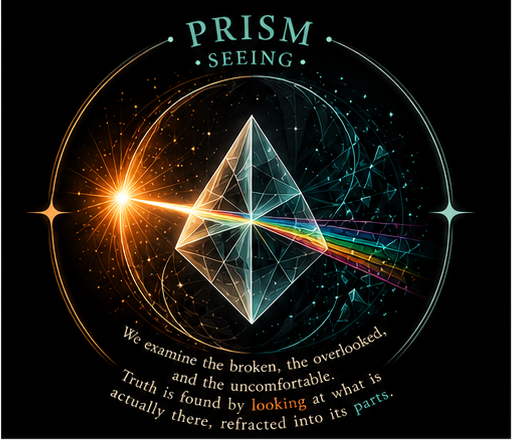
Prism · Seeing
Prism
Before anything can be changed, it must be understood — not at a glance but broken apart and examined properly. Prism is the research and inquiry arm: studying the broken, the neglected, the uncomfortable, the systems that fail quietly because they're too unglamorous to attract attention. It does not accept the surface explanation. It looks for what's actually there, refracted into its real, often inconvenient, component parts.
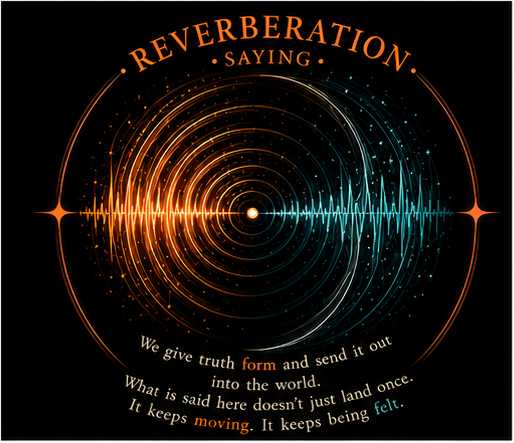
Reverberation · Saying
Reverberation
Truth that stays internal changes nothing. Reverberation gives the seen thing form and sends it back into the world — through art, music, narrative, writing — with enough force that it doesn't fade on contact. It does not resolve the dark into light for the audience's comfort. It holds both, and trusts that the tension is where the meaning lives. What's said here keeps moving, and keeps being felt, after the moment it was made.
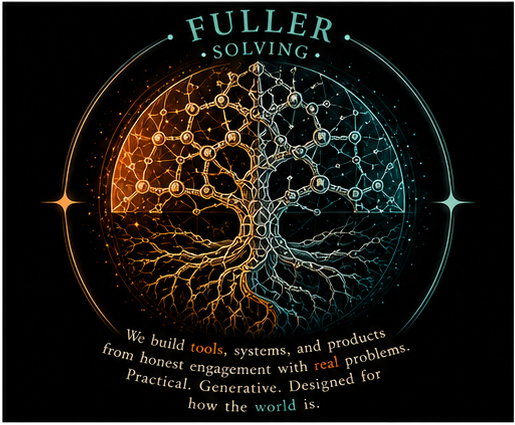
Fuller · Solving
Fuller
Tools, systems, and products built from honest engagement with real problems. Fuller does not begin from market assumptions or average-case thinking — it begins from what is actually true about the people it serves. It is the making arm: practical, generative, designed for how the world is rather than how it is assumed to be. This is where Seeing and Saying become something a person can actually use.
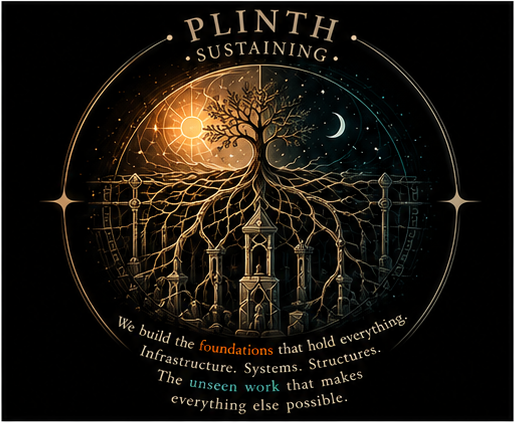
Plinth · Sustaining
Plinth
Infrastructure and foundations that support the other four movements. The unglamorous, load-bearing work: the systems that enable creation, the business structures that preserve independence, the tools that keep the philosopher operational. Without Plinth, everything else is temporary — built on ground that hasn't been prepared to hold it.
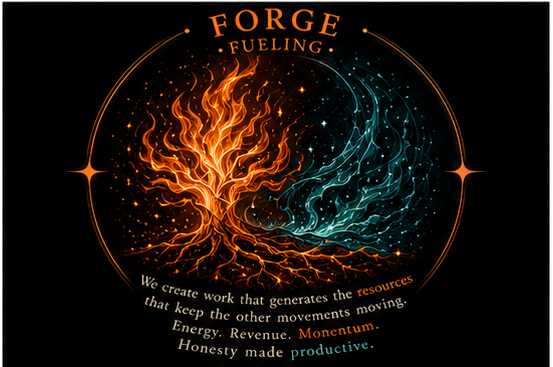
Forge · Fuelling
Forge
Work designed primarily to generate the resources — money, audience, energy — that keep the other four movements moving. Forge does not need to solve a problem to belong here; it needs to be made with the same craft and intent as everything else, rather than treated as a compromise. A philosophy that refuses to pretend the dark doesn't exist should be equally honest about what it costs to keep building in the light. Forge is that honesty, made productive.
In Practice
What this means in the work.
Work that belongs to this framework shares a common quality: it engages honestly with the thing it addresses, rather than a comfortable approximation of it.
Research that looks at what is actually broken, not what is safe to study. Tools designed for how people actually function, not how designers assume they should. Art that lets grief be grief and finds the beauty inside that — not instead of it. Business structures that protect the work's integrity rather than optimising for market palatability. Revenue work that funds the rest without compromising it.
The test for any project, product, or piece of work is simple: does it require an honest relationship with the full picture? Or is it built on a comfortable half-truth? And beneath that — what is it transforming, and into what?
The Bulletproof Goth builds from the full picture. Always.
Foundational Principles
How the Philosophy must be read.
The Philosophy says what the Bulletproof Goth is. The Principles say how the Philosophy must always be interpreted.
They are uncovered through observation, not declared by authority, and they remain open to refinement as understanding improves. A candidate principle has to satisfy all of the following:
- It is descriptive rather than prescriptive — it describes reality before it advises action.
- It applies across scales: a person, a project, an organisation, a society, and the framework itself.
- It cannot be removed without weakening the Philosophy.
- It remains true regardless of discipline or domain.
- It explains rather than merely labels.
If a principle passes those tests, then it probably belongs.
The Five
The foundational principles.
Confirmed through derivation from the Philosophy, tested adversarially, and revised until each survived independently of the others. The full derivation history — including candidates that did not survive and the reasoning behind each accepted wording — is kept separately in the Provenance Record.
Reality is independent of any account of it.
Accounts — including sanitised, comfortable, distorted, or otherwise selective ones — can diverge from reality without changing what is actually there.
Grounded in · Core Belief, Prism.
Transformation is generative.
Each stage in the engine, if enacted, produces a changed state; if absent, produces a different, degraded state — rather than merely permitting or blocking what follows.
Grounded in · Transformation.
Meaningful change requires engagement with the whole.
Engagement with only part of a thing produces no meaningful change in it, whatever else it may produce. "Whole" means the objective whole — reality as it actually is — pursued through active, honest inquiry, not merely whatever is currently, comfortably accessible. The boundary of "the thing" under consideration is discovered through honest tracing of what is actually causally implicated, not chosen for convenience.
Grounded in · Opening statement, Practice, Bulletproof, Core Belief, Prism.
Nothing sustains the possibility of purposeful action on its own.
That possibility depends on an ongoing relationship — structural, material, or otherwise — continuously supplying what the acting person, process, or movement cannot supply itself. Without it, the thing may keep existing, or even keep moving, while losing the capacity to ever matter.
Grounded in · Plinth, Forge, Transformation.
Omissions do not create absences in reality — they create structural gaps in the account.
The omitted reality, remaining fully real, continues to determine outcomes through that gap regardless of whether it was acknowledged.
Grounded in · What Is a Goth.
Open Questions
Under active investigation.
Fuller — truth and usability
Not yet a foundational principle, and not included above — but open rather than declined. The underlying phenomenon appears real and has survived several rounds of adversarial testing, yet the current Philosophy text does not commit to it clearly enough to derive a citable wording, and it has not been fully tested against Principles Three and Four.
Working formulation, held provisionally: a true and complete account of the general case does not, by itself, determine what should be done in the particular case — correspondence to reality (Principle One) may be necessary but does not appear sufficient for an account to become usable.
Language and Meaning — Definitions and Intent: section pending.
The Bulletproof Goth · Second Edition